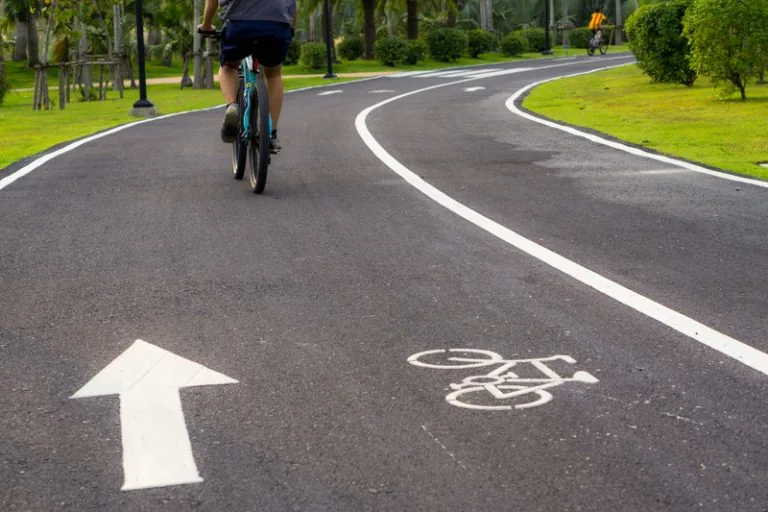
We pave bike paths for HOAs, developers, parks and recreation projects, campuses, business parks and private communities, and we build them to be ridden, walked, jogged and maintained for years.
Bike Path Paving Design: Width, Grade, Curves and Clearances
Good path geometry is what makes a bike path feel safe. Shared-use paths are commonly built 10 feet wide as a minimum for two-way travel, with 12 feet or more where heavy use is expected, and with a graded, clear shoulder of about 2 feet on each side so riders have room to recover. Cross-slopes are kept to about 2 percent for drainage and accessibility, and long grades are kept gentle, ideally 5 percent or less, because steep slopes are hard to climb and risky to descend. Curves are laid out with generous radii and good sight lines, and we coordinate with your engineer or designer wherever plans or agency standards apply.
Bike Path Paving Base: Crushed Rock Subbase and Frost Stability
A bike path is lightly loaded, but it still needs a stable platform. We strip organic soil, proof the subgrade and compact a crushed rock base in lifts, thickening it over soft or silty soils that can heave when they freeze. A firm, well-compacted subbase keeps the surface smooth through repeated freeze-thaw cycles and keeps small cracks from turning into trip hazards.
Bike Path Paving Thickness and Mix: Hot-Mix Asphalt Aggregate for a Smooth Ride
Most bike paths use about 2 to 3 inches of compacted hot-mix asphalt over the base. Where maintenance trucks, sweepers, snow equipment or emergency vehicles will use the path, we increase the section so wheel loads do not break the edges. A fine-graded surface mix, placed with a paver and rolled to density, gives riders a tight, smooth texture that sheds water and resists raveling.
Bike Path Paving Drainage and Tree Roots: Keeping the Surface Flat and Dry
Water and roots are the two big enemies of trail pavement. We crown or cross-slope the path so runoff leaves the surface, add swales or culverts where water crosses the route, and recommend root barriers or realigned routing near mature trees. Standing water makes ice in winter, and lifted pavement near roots creates the bumps riders hate most.
Bike Path Paving Markings and Safety: Centerlines, Symbols and Crossings
Markings turn a strip of asphalt into a functioning route. We can coordinate centerlines to separate two-way traffic, edge lines for low-light visibility, directional arrows, bicycle symbols, and stop bars and crosswalk markings where the path meets a street or driveway. Crossings need particular care: ramps are set to accessible slopes, grades flatten ahead of the intersection, and the pavement transitions smoothly into the roadway. See our walkway paving page for pedestrian-only routes and our subdivision road paving page for the streets these paths connect to.
Bike paths also tie into larger trail networks, such as the Spokane River Centennial Trail, and people expect new paths to feel as continuous and well kept as those. If you have an older path that has cracked, heaved or washed out, asphalt repair or an asphalt overlay can often restore it without rebuilding the entire route.
Planning tip: Narrow-width pavers and small rollers let us work along tight corridors, wooded routes and existing landscaping without damaging adjacent turf, trees or irrigation.
Bike Path Paving Process: Alignment to Final Markings
- Route walk and alignmentWe walk the corridor with you, stake the centerline and flag trees, utilities and drainage crossings.
- Clearing and excavationOrganic soil and unsuitable material are removed to the planned depth.
- Crushed rock baseBase is placed in lifts and compacted for a firm, frost-resistant platform.
- Grade and drainage checkCross-slopes, running grades and crossing ramps are verified before paving.
- Hot-mix asphalt placementA narrow-width paver or hand tools place the asphalt at consistent thickness.
- Rolling and edge finishingRollers compact the mat to density and the shoulders are graded to match the edge.
- Pavement markings and cleanupCenterlines, arrows and symbols are applied and the corridor is cleaned and restored.
Bike Paths Service Areas: Spokane, Spokane Valley, Liberty Lake, Cheney and Airway Heights
We provide bike paths throughout Spokane County. Choose your location to see local conditions, soils and paving considerations for your area.
- Bike Paths in Spokane, WA
- Bike Paths in Spokane Valley, WA
- Bike Paths in Liberty Lake, WA
- Bike Paths in Cheney, WA
- Bike Paths in Airway Heights, WA
Bike Paths FAQ: Answers From a Spokane Paving Contractor
Bike Path Paving Width: How Wide Should a Shared-Use Path Be?
Ten feet is a common minimum for two-way paths, with 12 feet or more for busy routes, plus clear shoulders on each side. We design for your expected use and any agency or HOA standards.
Bike Path Paving Cost: What Affects the Price per Foot?
Path width, length, base condition, clearing and grading needs, drainage crossings and access all affect price. A site walk is the only reliable way to price a route.
Bike Path Paving Winters: Will Freeze-Thaw Damage a New Path?
Any pavement is stressed by freeze-thaw cycles, but a compacted crushed rock base, good drainage and well-compacted asphalt make a path far more resistant. Prompt crack sealing keeps small cracks from spreading.